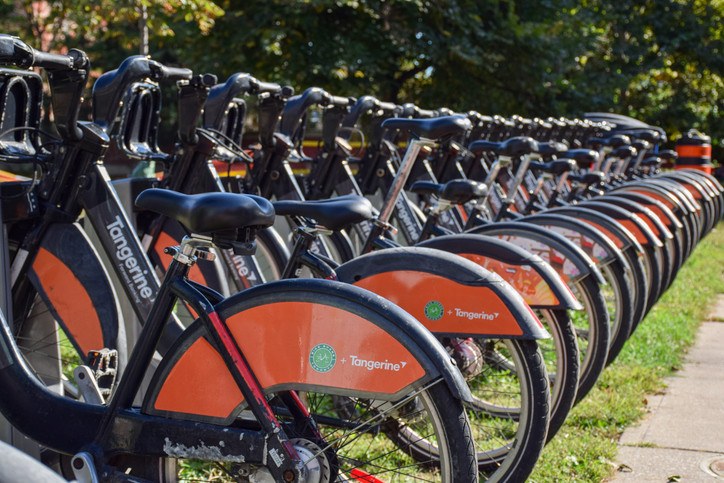

Cities across Canada are expanding and strengthening bike share systems, reinforcing their role as a practical tool to reduce emissions, ease congestion and improve access to transportation.
Bike share is a public transportation solution where a network of bikes is available on demand 24/7 at a low cost. It can support efficient movement of people in a city and support transit by connecting people at the start or end of their trips.
In Toronto, the popular Bike Share TO system announced it is adding almost 1000 new bikes (a mix of regular and electric) this season to meet growing demand. The system launched in 2011 and has grown steadily. It now reaches every ward of the city, and keeps breaking ridership records and revenue projections. In 2025, the system brought in $2.3 million more than projected. Importantly, Toronto looks to bike share to ease congestion expected around the FIFA World Cup this summer.
In Québec City, àVélo is adding 500 e-bikes to its fully electric system. The system, which launched in 2021, has grown from 100 bikes at 10 stations to 2300 bikes at 225 stations in just 5 years. The service now reaches suburban boroughs like Chutes-Montmorency and Cap-Rouge. Bike share is seen as a mitigation to congestion created by major construction in the city.
Hamilton Bike Share isn’t adding more bikes or locations this spring, but it is celebrating consistently strong ridership after several years of precarity. Ridership has increased dramatically in the past two years, with 700,000 rides (+38%) in 2025. The system credits more safe bike infrastructure in the city, a student U-Pass bike, plus strong community support with its success.
And on the west coast the Metro Vancouver area has a number of growing bike share systems and a growing movement to ensure they are better integrated across jurisdictions. In February, Hub Cycling and about here released “The Bike Share Dilemma”, a short film detailing the opportunities of bike share and the challenges found without public-backing and regional coordination. The film has already led to action at the city council table with near-unanimous support for a motion to grow Vancouver Bike Share and advocate for a coordinated regional system.
What this means for Ottawa
A clear pattern is emerging: bike share is helping cities advance core municipal priorities, the same priorities Ottawa is working toward, including:
- Reducing traffic congestion
- Expanding affordable, reliable, and convenient transportation options for residents
- Increasing transit ridership and cycling mode share
- Supporting regional mobility so people can easily move between Ottawa and Gatineau
- Improving air quality and supporting quieter neighbourhoods and healthier residents
- Improving access to major events and destinations
- Reducing greenhouse gas emissions
EnviroCentre has been championing conversations about bike share in Ottawa-Gatineau. In 2024 we released a report called Bike Share in Ottawa-Gatineau: A Missing Piece of the Local Transportation Puzzle. This report confirms that there is strong community support for bike share.
The report outlines how bike share can support a more connected, affordable and low-carbon transportation system in the region and highlights strong public interest in bringing the service back. Drawing on evidence from systems across North America, it also identifies best practices and key considerations for implementation.
As Ottawa considers how to strengthen its transportation system, there is a clear opportunity to align with peer cities and advance a bike share system that supports climate, mobility and affordability goals.
With next steps expected from the city shortly, we hope that bike share in Ottawa-Gatineau will be blossoming soon, too.
Read our report to explore what a bike share system could look like in Ottawa–Gatineau and how it could help fill a key gap in the region’s transportation network.