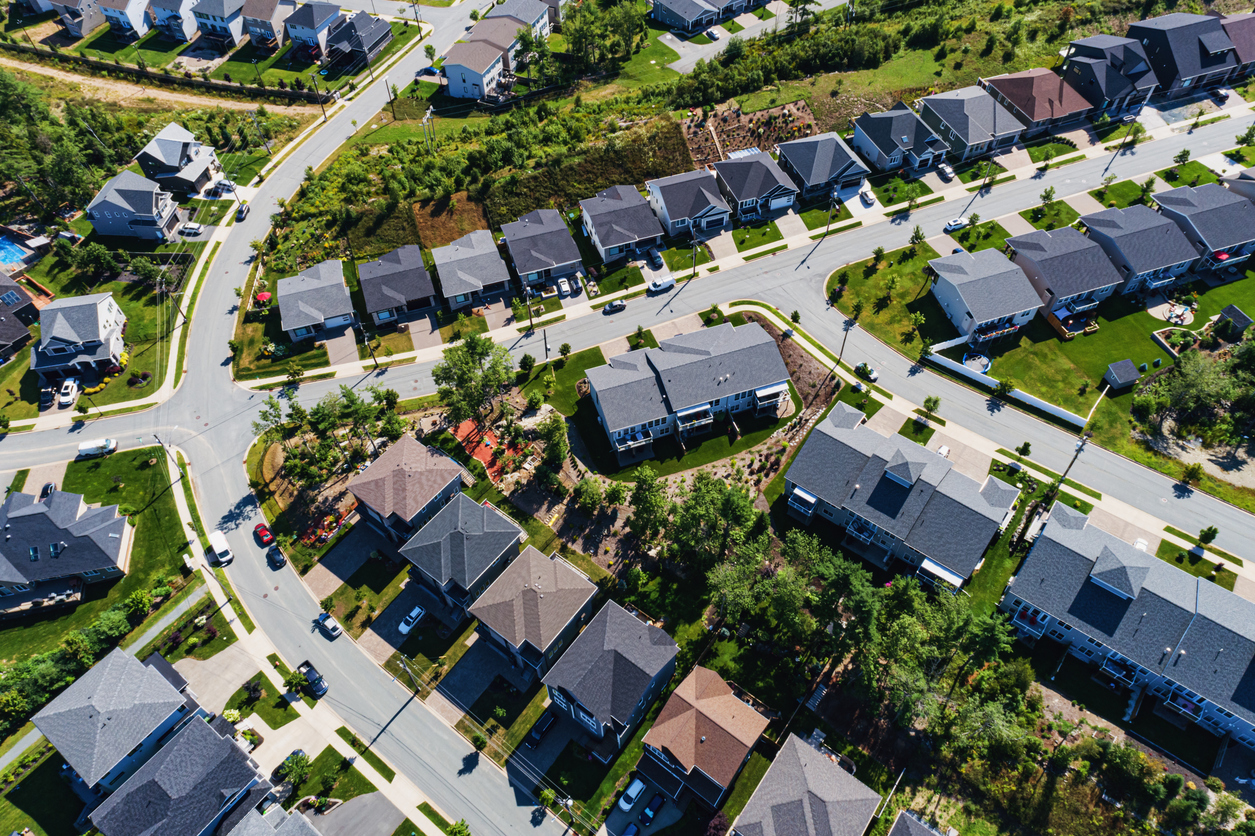

A new literature review from EnviroCentre’s Retrofit Accelerator team asks a critical question: what will it take to make those buildings work better for people and for the planet?
Every day, the buildings we live in quietly shape our health, comfort, and cost of living, and they tell a story about who our systems are designed to serve.
In social and affordable housing across Eastern Ontario, that story is often one of aging buildings, rising energy costs, and residents navigating overlapping challenges. These buildings are also a major source of greenhouse gas emissions. Deep retrofits – comprehensive upgrades that dramatically reduce energy use and emissions – offer a powerful opportunity to change that story.
When done well, deep retrofits can lower emissions, improve indoor comfort and health, reduce energy poverty, and build resilience to extreme weather. They can be a climate solution and a social one. Yet despite growing recognition of their importance, progress has been slow, fragmented, and uneven – especially in social housing.
This is where our work begins.
EnviroCentre’s Retrofit Accelerator team completed a review of current research, looking at current policy, industry reports, and case studies to better understand what it will take to scale low‑carbon, equitable deep retrofits in social housing across Eastern Ontario and beyond.
The evidence is clear, but so are the challenges.
What the literature tells us
Deep retrofits are widely recognized as essential to meeting Canada’s 2030 and 2050 climate targets. Incremental upgrades alone will not deliver the scale of emissions reductions required. At the same time, the literature shows that social housing has strong potential to deliver wide‑ranging benefits, from improved health and comfort to greater affordability and energy justice.
But the path forward is not straightforward.
Across Canada and internationally, retrofit progress is shaped by a recurring set of barriers:
- Fragmented governance, with misalignment between federal, provincial, and municipal roles
- Complex and unstable funding, often favouring shallow upgrades over deep transformation
- Workforce and supply chain constraints, particularly for specialized retrofit skills and materials
- Equity gaps, where programs fail to fully reach or benefit the communities most in need
The research also highlights something often overlooked: deep retrofits deliver benefits far beyond energy savings. Improved indoor air quality, thermal comfort, resilience to heat and cold, reduced maintenance costs, and local job creation all strengthen the case for action – yet these outcomes are rarely measured or valued consistently.
Learning from what works
The review draws on case studies from Canada and abroad that show scaling is possible.
Successful approaches tend to share common features: strong public investment, coordinated policy signals, aggregation of projects to reduce costs, investment in workforce capacity, and, critically, meaningful engagement with residents and communities. Where equity, affordability, and lived experience are treated as core design principles rather than add‑ons, projects are more durable and impactful.
At the same time, the literature reveals important gaps, particularly in region‑specific data, long‑term evaluation of retrofit outcomes, and Indigenous‑led and community‑driven approaches. Addressing these gaps is essential if deep retrofits are to move from isolated successes to systemic change.
A clear opportunity
What emerges from this review is not a single solution, but a clear opportunity.
With better alignment between ambition and implementation, deep retrofits in social housing can become a cornerstone of Eastern Ontario’s climate response, while also advancing health, affordability, and equity. This work provides an evidence‑based foundation to support more coordinated planning, collaboration, and long‑term thinking.
It’s not about reinventing the wheel. It’s about connecting what we already know, learning from what’s worked elsewhere, and applying those lessons thoughtfully in a regional context.
What comes next
This literature review is a starting point. Its findings will inform the next phase of EnviroCentre’s work: developing a regionally grounded roadmap for scaling low‑carbon, equitable deep retrofits in social housing across Eastern Ontario. By identifying where evidence is strong, where gaps remain, and where systems are misaligned, this work aims to support decision‑makers, housing providers, and communities in moving from intention to action.
Read and download the full report to explore the findings, insights, and evidence in more detail.