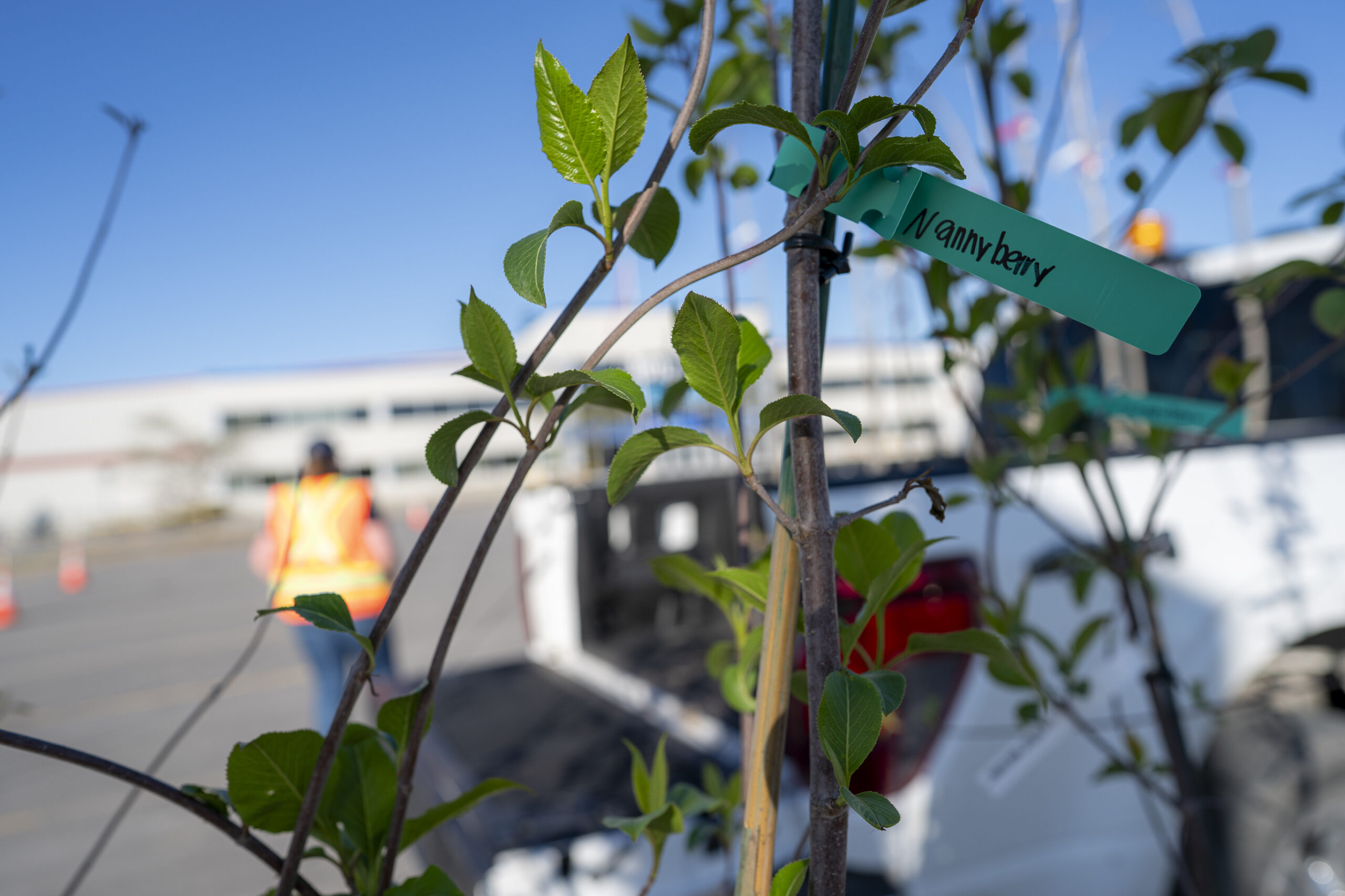

In municipalities across Canada, urban heat is intensifying, flood risk is rising, and residents are feeling the effects. Trees are among the most effective and cost-efficient tools that cities have for responding. An initiative led by the Federation of Canadian Municipalities (FCM) aims to help municipalities make the most of that tool by providing funding and planning assistance for ambitious, impactful tree-planting programs in communities of all sizes. In this post, we share key information about the Growing Canada’s Community Canopies (GCCC) grant, tips for applying, and two project examples drawn from our experience running successful tree planting programs in Ottawa.
Why urban tree planting matters
When done well, urban tree-planting programs have long-lasting benefits for residents, the municipality, and the environment. These programs:
- Help municipalities work towards tree canopy targets and urban forest management goals.
- Build climate resilience and improve public health by reducing urban heat, improving air quality, managing stormwater, and sequestering carbon.
- Create more equitable neighbourhoods through programs that prioritize low-canopy areas at the greatest risk of heat and flooding.
- Encourage community engagement and environmental stewardship through programs that target residents and private landowners.
- Deliver long-term returns as trees appreciate in value as they grow.
Funding tree planting projects: the GCCC grant
Growing Canada’s Community Canopies (GCCC) is a $291 million federal initiative that aims to plant at least 1.2 million new trees across Canada by 2031. Delivered through FCM’s Green Municipal Fund, the program supports tree planting in municipalities of all sizes, with funding available for a range of project types, including community-wide urban planting, forest restoration, school and institutional planting, and private land programs.
The current round of funding closes on June 30, 2026, with future rounds anticipated. Applications are open to municipalities and non-municipal organizations that apply in partnership with a municipality.
Fast facts about the GCCC Fund
- Covers up to 50% of eligible project costs
- Minimum $50,000 total project value
- Maximum grant of up to $10 million per municipality over the lifetime of the program
- Infrastructure costs (e.g., de-paving, stump removal, irrigation systems) are eligible up to a $1 million lifetime cap
- Cannot fund projects that have already received 2 Billion Trees funding
- Planting must be completed within two years of funding approval, with one additional year of maintenance
- 10% of the grant amount is held back until a one-year monitoring and maintenance report is submitted
Planning for success
Good programs are built on good questions. Before diving into the specifics of design, it’s worth working through these four foundational areas:
- Goals: What are your local canopy targets? Do you have a formal urban forest management plan?
- Priorities: Which neighbourhoods have the lowest canopy cover and greatest need?
- Partnerships: What local partners can you work with? Environmental non-profits, Conservation Authorities, schools, BIAs, housing providers?
- Funding: What funding is available? How can external funding extend municipal investments?
Getting clear on these early helps strengthen your funding application and increases the likelihood that your project will grow from a one-time planting event into a program that builds lasting canopy cover where it’s needed most.
Creating programs that work
With your broad goals in place, the next step is program design. GCCC funding supports a wide range of approaches, giving municipalities flexibility to design programs that fit their context. At EnviroCentre, we’ve built successful programs targeting private land, small public spaces, and schools. Here’s what we’ve learned.
Private land for shared benefit: Plant Your Place!
In many cities, public land alone isn’t enough to reach urban canopy targets. Engaging private landowners is essential to bridge the gap.
One successful example of this strategy is Plant Your Place!, a free residential tree planting program that received funding through the GCCC grant and was delivered by EnviroCentre in partnership with the City of Ottawa. The program offers citywide tree distribution events where residents can pick up a free tree to plant on their own property, as well as a full-service stream where a professional tree planting service visits the home, assesses the site, and plants the tree at no cost. Through this dual-stream design, the program can grow Ottawa’s urban tree canopy by reaching private land while also prioritizing low-canopy, lower-income neighbourhoods where the need is greatest.
Why it works
The program is designed to remove many of the common barriers to residential tree planting. Participation is simple and accessible; trees and planting guidance are provided at no cost, and the two-stream model ensures that resources flow to the neighbourhoods that need additional canopy the most, not just the ones that are easiest to reach. By supporting residents through the planting process, the program also builds the kind of personal investment that turns a one-time participant into a long-term steward.
Program impact (2025)
- 1,200+ free trees distributed to homeowners citywide
- 50 trees planted at seven community housing locations in low-canopy neighbourhoods
- In 2026, the program will double those numbers
High impact sites: Trees for Schools
Schools have several attributes that make them some of the most impactful sites for urban tree planting. They are major non-residential landowners, important anchors in the community, and, at the same time, particularly vulnerable to the effects of extreme weather, including heat waves and heavy rainfall. Planting trees on school grounds can help create cooler, more resilient outdoor spaces, build environmental stewardship in the next generation of residents, and inspire awareness and action in the surrounding community.
Trees for Schools is a newly launched program designed to bring natural spaces to school sites across Ottawa, paired with curriculum-linked activities developed in partnership with the Canadian Geographical Society.
Why it works
Many schools are interested in planting trees but face barriers such as limited budgets, staff capacity, or technical expertise. Trees for Schools helps bridge that gap by providing support for planning and implementing tree-planting projects. The program incorporates principles of the Tiny Forest model, a proven planting method that uses native trees, rich amended soil, and tight planting densities to create fast-growing ecosystems in small spaces. By connecting tree planting to classroom learning, the program also gives students a direct stake in the health of their local environment and gives teachers a living classroom to work with.
Projected impact (2026-2027)
- 12 tiny forests
- 600+ large individual trees
- 20+ sites across 4+ school boards
Applying for GCCC funding
The full application deadline is June 30, 2026, with future funding rounds anticipated. Applications are open to municipalities and non-municipal organizations applying in partnership with a municipality.
To apply, you’ll first need to submit a pre-application, which GMF staff will review and provide feedback on to ensure your project is aligned with GMF’s priorities. If your project is eligible, you will receive instructions to submit a full application.
The good news is you don’t have to figure it out alone. FCM’s Green Municipal Fund offers free one-on-one application coaching, expert urban forestry support, and ready-made templates and guides. And if you’re interested in one of our turnkey solutions or in supporting the creation of something new, EnviroCentre has the experience to help.
Get in touch to find out how we can work together.