Taste of Wellington: Testing low-carbon transportation solutions for community events
Many places are designed around how we expect people to arrive, not how they actually do.
Whether it’s a main street, a public space, or a community event, transportation decisions are often based on assumptions. Driving becomes the default, even when many people live nearby or would prefer to walk, bike, or take transit if those options felt safe, convenient, and supported.

EnviroCentre helps organizations move from assumptions to evidence by observing real behaviour, testing small, practical interventions, and generating data that supports better, people-centred decisions. At the Taste of Wellington festival, EnviroCentre partnered with the Wellington West Business Improvement Area (BIA) to put this approach into practice.
The challenge for the client
Business Improvement Areas (BIAs) like the Wellington West BIA are responsible for animating places that are shared by many users at once—businesses, residents, visitors, and people moving through the neighbourhood. Their events are meant to bring people together, support local businesses, and create lively public space.
In practice, how people arrive strongly shapes whether these goals are achieved.
When many visitors come by car, streets quickly fill with traffic and parking activity. Drivers circle for spaces. Intersections become more complex and less comfortable to cross. Noise and vehicle movement compete with conversation, patios, and programming. Most of the public right-of-way remains dedicated to the movement and storage of automobiles, while people are concentrated on narrow sidewalks.
At the same time, event organizers are often making transportation decisions without clear information about how people actually travel or what would support different choices. While EnviroCentre estimates that 6–8% of Ottawa event attendees would like to bike, many organizers lack access to practical solutions—such as secure bike parking—or the capacity to test them. Large festivals like Bluesfest have offered bike valet parking for decades, but smaller events often struggle to implement similar supports.
The challenge for the climate
Transportation choices at events are small decisions that add up.
Cars, SUVs, and light-duty passenger trucks account for nearly 12% of national greenhouse gas emissions, and transportation is the largest source of community emissions in Ottawa.
Beyond tailpipe emissions, automobile-oriented systems reinforce patterns that increase emissions over time. They require more space for travel and storage, encourage longer trips, and limit opportunities to repurpose public space for people, trees, and social life. When driving is the easiest or only supported option, low-carbon choices remain underused—even in places where many trips could be short.
The challenge for people
People’s travel decisions are shaped by what feels easy, safe, and predictable.
Event information often prioritizes driving, with clear directions and parking details, while information about walking, biking, or transit is limited or absent. Events are frequently held on evenings or weekends when transit service is reduced, making trips longer and less reliable. For people who cycle, concerns about theft—especially for e-bikes, cargo bikes, or adaptive cycles—can be a decisive barrier.
Because events are often outside people’s daily routines, choosing alternatives to driving requires additional effort, confidence, and information. When that support is missing, many people default to the car, even if they would prefer another option.
Our solution
EnviroCentre worked with the Wellington West BIA to test whether small, practical transportation interventions could improve the experience of the event—while generating data to support future decisions.
A two-pronged pilot approach was implemented:
- Bike and scooter valet parking to support micromobility and test a visible, people-centred intervention
- Intercept surveys to understand how attendees travelled and what influenced their choices
Bike and scooter valet parking
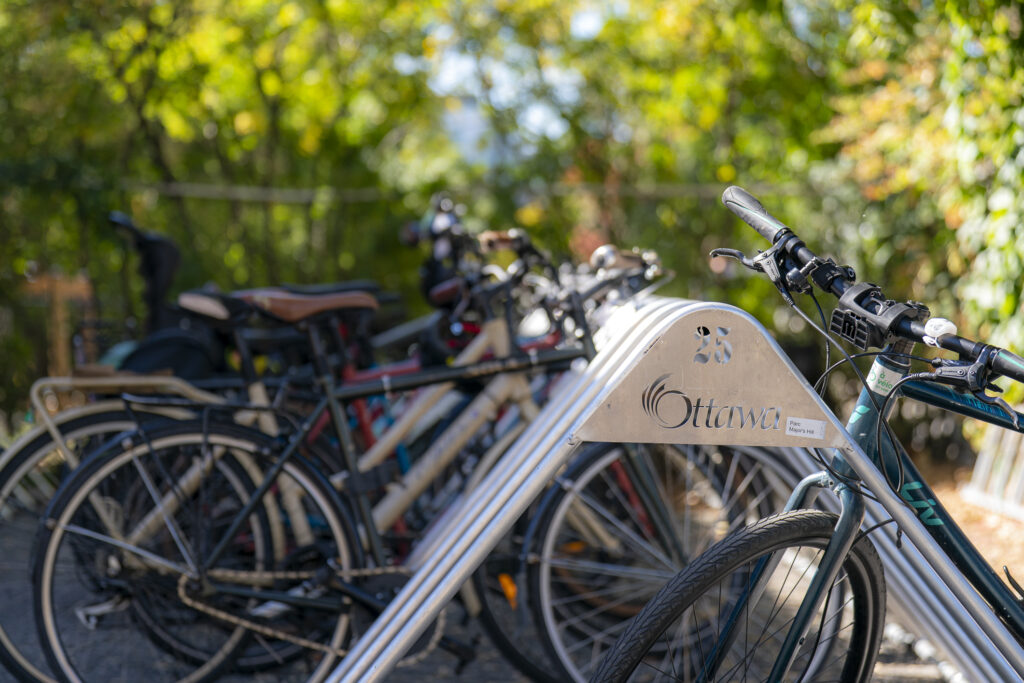
Bike and scooter valet parking provides a secure and convenient way to store micromobility vehicles during events. EnviroCentre worked with the Wellington West BIA to identify a central, highly visible location that was easy to access from the cycling network and had sufficient space for temporary bike racks.
The valet service was promoted through Taste of Wellington materials, including a stylized festival map. Staff registered bikes and scooters, monitored them throughout the event, and returned them safely at the end of each visit. The service was provided free of charge.
Results:
33 bikes
were parked during the event
100% of users
said they would use the service again
93%
said they would be more likely to attend events that offer bike and scooter valet
Primary reasons for using the service were fear of theft (74%) and convenience (58%)
Intercept surveys
To better understand real travel behaviour, EnviroCentre conducted random intercept surveys with 100 attendees at two locations during the festival. Participants were asked a short series of questions about their transportation choices, decision-making factors, and demographics.
What we learned
We surveyed 100 random attendees and found only 33% arrived at the event by private automobile.
This event attracted an even mix of neighbourhood residents and visitors:
- 54% live in Wellington West or immediately adjacent neighbourhoods like Westboro, Civic Hospital, Little Italy and Chinatown.
- 20% live in other inner urban or downtown neighbourhoods, 10% live in outer urban neighbourhoods, 7% in suburban neighbourhoods, 5% in Gatineau, and 3% were out-of-region visitors.
- Regardless of mode of transportation, respondents said they made their travel decisions based on convenience (51), travel time (41), parking (23), and weather (9)
- For car travellers, travel time was a greater concern. The weather was not factored into their decision-making.
- Most respondents walked (53%) to Wellington West, particularly those aged 65 and older.
Respondents would consider walking, biking, or taking transit with:
- More frequent public transit service, including inter-provincially (10)
- More certainty that public transit would be a reliable option (7)
- Safe bike routes (2)
- Most respondents discovered a new business (69%) and on average expected to spend about $40 that day.
- 10% of respondents expected to spend more than $100, including people who came to the area by walking, driving, biking, scooting, and taking transit.
Direct impact
Five valet users said they would not have biked or scooted to the event without the service. Together, they travelled 61 km by bike or scooter, avoiding approximately 7 kg of greenhouse gas emissions.
Potential impact at scale: Ottawa hosts over 100 major annual festivals and thousands of smaller and one-time events. A conservative estimate suggests that scaling bike and scooter valet services could avert more than 3,500 kg of GHG emissions annually, based on 7% of attendees at 100 major events with 5,000 attendees each travelling 8 km round-trip.
“I am thrilled to have this bike valet option!”
— Valet customer
Partners & Supporters
- Wellington West BIA
- Bridgehead (Intercept survey incentives)
- Ottawa West Community Support (Valet parking location)
If you’re facing a complex challenge where behaviour, place, or systems matter, a targeted pilot can reveal insights that planning alone can’t.
EnviroCentre supports partners to observe real-world behaviour, test practical interventions, and evaluate outcomes—before scaling solutions across programs, places, or policies.